
Laggards yet, a number of smaller PSBs in the category have balance sheets which do not give much comfort.

Hinduja Group expanding in defence sector in big way: Gopi

Renowned women's rights activist and founder of the Self Employed Women's Association (SEWA) Ela Bhatt passed away in Ahmedabad on Wednesday due to age-related ailments, her associates said.

Fix India's real estate sector. Fix India's public sector banks, advises Tamal Bandyopadhyay.

According to the latest Budget papers, the staff strength of central ministries and departments is estimated to rise by 276,796 to 3.44 million at the end of FY23, it would be up by 109,266 to 3.55 million in March 2024.
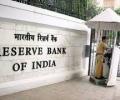
RBI is likely to have reached broadly similar conclusions since it did cut rates, presumably to stimulate activity.

Due to the prevailing uncertainty, the risk of loans going bad has certainly increased. This may result in lenders following risk-based pricing more diligently, notes Naveen Kukreja, CEO, Paisabazaar.com

The finance minister has said that United Bank has managed to reduce its non-performing assets.
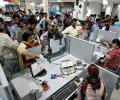
Insolvency professionals feel the bankruptcy code will deter defaulters, but NPAs will not cease unless banks are sensitised on credit appraisal and experts are hired by banks to inspect what is happening with their loans.

In the manufacturing sector, output is expected to decline by about 70 per cent as only food-processing, and drugs and pharma industries are allowed to operate while other segments, such as engineering and metals, have shut operations.

19 per cent of all travel in India (by bus, train or air) was pilgrimage or religious travel (possibly the single largest after business and family-related travel), discovers Ambi Parameswaran.

BSE benchmark Sensex nursed losses on Friday as investors pocketed gains after a five-session winning streak amid a bearish trend overseas. A depreciating rupee and foreign fund outflows further soured risk sentiment, traders said. The 30-share gauge, which had started the trade on a firm note, soon gave up all the gains and finally ended 651.85 points or 1.08 per cent lower at 59,646.15. The broader NSE Nifty snapped its eight-day rally to close at 17,758.45, down 198.05 points or 1.10 per cent.
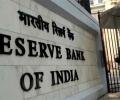
Headed by Urjit Patel, MPC for the fourth straight time kept the repo rate unchanged, at which it lends to the banks, at 6.25 per cent. The reverse repo, at which RBI borrows, will be 6 per cent.

'We would advise investors to invest in a disciplined way in equities for the long term.'

We will find it difficult to exceed an average of 5 per cent growth in the medium term, warns Shankar Acharya, the former chief economic adviser.

India's Gross Domestic Product (GDP) is expected to expand by 9.2 per cent in the current financial year, according to the Economic Survey 2021-22 tabled in the parliament on Monday. "Advance estimates suggest that the Indian economy is expected to witness real GDP expansion of 9.2 per cent in 2021-22 after contracting in 2020-21. "This implies that overall economic activity has recovered past the pre-pandemic levels," Economic Survey noted. Almost all indicators show that the economic impact of the "second wave" in Q1 was much smaller than that experienced during the full lockdown phase in 2020-21 even though the health impact was more severe, it said.

Edtech unicorn Vedantu has laid off 385 employees, nearly 11.6 per cent of the company workforce, according to sources. This move is being seen as part of a drive in the edtech sector towards profitability via cost-savings and consolidation, as funds dry up, they said. The Bengaluru-based firm has laid off over 1,100 employees (both full-time and contractual), so far, this year.

This will be done across five cities - Delhi, Bengaluru, Coimbatore, Bhopal, and Shillong. Thereafter, it will be scaled up and launched in 100 cities over a period of six months, said a senior government official.

Cash-strapped SpiceJet has cancelled over 1,800 flights across the country for the current month, in signs of mounting troubles for the budget airline.

Axis Bank was the top laggard in the Sensex pack, plunging more than 5 per cent, followed by HDFC, Bajaj Finance, ICICI Bank, Tata Steel, Bajaj Auto, HDFC Bank and IndusInd Bank. On the other hand, M&M, Infosys, Asian Paints, UltraTech Cement and Tech Mahindra were among the gainers.


Finance Minister Nirmala Sitharaman will present the much-awaited 2022-23 Union Budget on February 1. While there has been strong recovery in some sectors, touch services like hospitality, tourism and leisure continue to suffer after two Covid-19 waves. Household savings have been hit due to increased spending on health care. Consumption has still not reached pre-pandemic levels.

'India seems to be on a relatively better wicket compared to other emerging markets.'
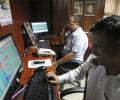
Among PSBs, the top gainers have been Union Bank of India and Corporation Bank, whose shares have rallied more than 15% each. Indian Bank and Bank of Baroda, too, registered double-digit rise

It has mostly been a one-way street for markets that have moved up sharply since July. The front-line indices - the S&P BSE Sensex and the Nifty50 - have gained 6.7 per cent and 7.3 per cent, respectively, in the past three months. The rally in mid- and small-caps has been sharper, with both indices surging 14 per cent and 9 per cent, respectively, during this period. This sharp run has made analysts at Jefferies cautious.

The expected interest rate hike in the US and the resultant volatility in the domestic secondary market could play a dampener to the over Rs 2-trillion initial public offering (IPO) pipeline in 2022. IPOs in 2022 look promising, with as many as 35 companies holding the Securities and Exchange Board of India's approval to raise roughly Rs 50,000 crore. Another 33 companies are waiting for the regulator's nod to raise around Rs 60,000 crore next year.

More activity in the IT, health care, services sectors; manufacturing firms keeping fingers crossed.

Last year, the software giant launched a cloud adoption programme for SMBs.
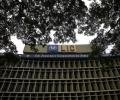
Initial public offering (IPO)-bound Life Insurance Corporation (LIC) of India's assets under management (AUM) increased to Rs 38 trillion as of September 2021, compared with Rs 37 trillion as of March 2021, said sources in the know. Its AUM is almost 3x the AUM of all the private life insurers in the country and over 15x more than the AUM of the second largest life insurer, SBI Life, as of September 2021. SBI Life's AUM was approximately Rs 2.4 trillion as of September 2021, said sources.

India Inc on Friday said it is looking forward to a repo rate cut in future as cost of funds has to come down in coming times, and expects continuation of accommodative policy stance by the Reserve Bank of India (RBI). The RBI decided to leave the benchmark interest rate unchanged at 4 per cent but maintained an accommodative stance, as the economy faces the brunt of the second COVID-19 wave. Sanjay Aggarwal, president of PHD Chamber of Commerce and Industry, said the RBI has maintained an accommodative stance as long as necessary to revive and sustain growth on a durable basis and to mitigate impact of COVID-19, apart from an aim to keep inflation within the target.
Your money is protected by the Deposit Insurance and Credit Guarantee Corporation.

United Progressive Alliance-led government proposed lenders as insurance brokers; new FM not too keen, say insurers.

The one-year returns for equity-oriented mutual fund (MFs) schemes have largely mirrored the gains made in the secondary market. However, schemes that invest in infrastructure (infra), small-cap, and public sector undertaking (PSU) banks have emerged standout performers, with gains in excess of 100 per cent in some cases. Of the total 484 equity schemes, 353 have managed to beat the Sensex, reveals the data provided by Value Research. Around 20 have delivered returns in excess of 90 per cent and six schemes have given returns of over 100 per cent in the past one year. The S&P BSE Sensex Total Return Index (TRI) has given returns of 51 per cent in the last one year, ended October 29.

Reserve Bank Governor Shaktikanta Das on Thursday said the central bank's asset purchases, aimed at mitigating COVID-19-related liquidity stress in the system, did not dilute its balance sheet or compromise on core principles of central banking. In the wake of the pandemic, the RBI undertook several conventional and unconventional measures. "Unlike many central banks, the RBI's asset purchases did not dilute its balance sheet and hence, did not compromise on core principles of central banking," Das said while addressing an event organised by the Bombay Chamber of Commerce. These purchases were confined to risk-free sovereign (government) bonds including state government securities only, he said.

The government's largesse was widely expected after the ruling Bharatiya Janata Party lost power in the recent assembly polls in three Hindi heartland states, where rural distress was cited to be one of the reasons for the defeat of the saffron party.

India will grow at around 7.4 per cent in 2022-23 and continue at the same pace in the next year as well, Union Finance Minister Nirmala Sitharaman said on Friday. Sitharaman said there are risks on the external front and this is not the right time to throw caution to the wind, and also assured exporters of all the necessary support from the government as they face the headwinds. Speaking at the FE Best Bank Awards event here, Sitharaman said global agencies like IMF and the World Bank have taken cognisance of the strengths of the Indian economy by saying that it will be among the fastest growing ones in the next two years.

Reserve Bank on Wednesday announced a slew of measures including loan restructuring for individual and small businesses hit hard by fresh COVID-19 wave. To augment supply of goods for COVID care, the central bank opened Rs 50,000 crore on-tap window to ease access to emergency health services to boost provision of immediate liquidity for ramping up COVID-19 related healthcare infrastructure and services in the country. This liquidity window is being opened till March 31, 2022, he said, adding that under the scheme, banks can provide fresh lending support to a wide ranging of entities including vaccine manufacturers, importers and suppliers of vaccine and medical devices, hospitals and dispensaries and suppliers of oxygen and ventilators importers and also patients for treatment.

Investors have scaled back their allocation to equities as pessimism has reached "dire" levels due to cloudy economic outlook, according to the latest Bank of America (BofA) monthly global fund manager survey that covered nearly 300 money managers with combined assets of $800 billion. The survey showed that the expectations for global growth and profits are at all-time lows and cash levels are at highest since the 9/11 attacks. Interest rate hikes by central banks, the unwinding of an easy monetary regime, disruptions in global supply chains, and fears of recession have heightened market volatility since the beginning of the year.

The challenge of cleaning up the taxation system and introducing the goods and services tax (GST) regime cannot be underestimated.

With Lok Sabha elections months away, the visits are vital politically as these would showcase Modi's standing as a world leader to the home electorate.
